
The Naked Magdalene
recovering the radical path of our ancestral mothers

Be passersby. Be no one.
Yeshua in The Gospel of Thomas
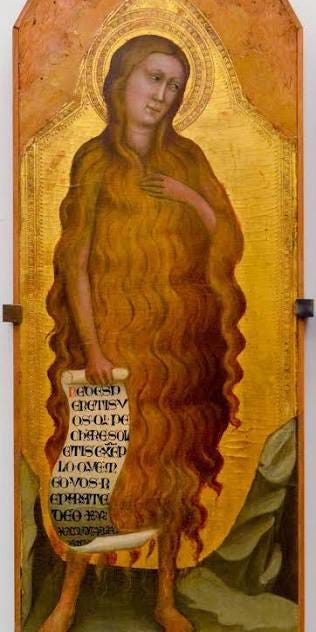
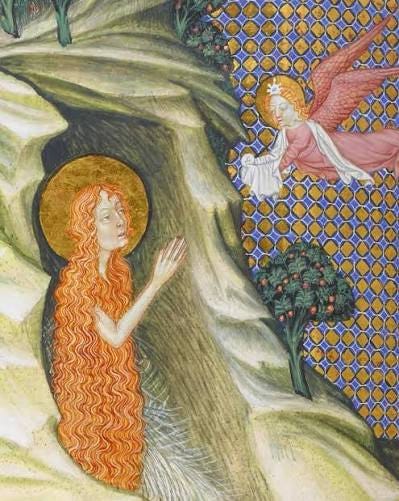
Legend has it that after the death of Jesus, Mary Magdalene and various companions were carried in a rudderless boat to the shores of southern France. She is said to have retreated to a nearby cave where, dressed only in her hair, she devoted herself to prayer and healing. Each day the angels came and lifted her to heaven to feed her with the mystical body of her beloved. Legend has it that she was not just Christ’s disciple—but his wife, the mother of his child, his twin flame, Isis to his Osiris, goddess to his god.
In recent years the need to recover her story and restore her place of prominence within Christian theology has felt both urgent and essential. God is not just male. God does not privilege celibacy. Woman can be priests, or priestesses, too. She has her own rites and rituals and esoteric teachings. The boys have Jesus and his lilies and now the girls have Mary Magdalene and her roses. The scales have been balanced at last.
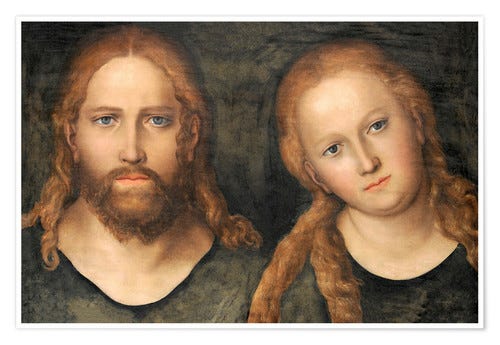
Yet asking the Magdalene to both reform institutional religion and submit to its assumptions risks obliterating the reality of her rejection of all of civilization’s expectations. Christianity, even at its most progressive, destroys the message of the man who spoke of what it might look like to walk away from empire altogether and live again, like our paleolithic ancestors, trusting the earth each day to feed and clothe us. Yeshua told his disciples to go forth into the world with nothing but faith—no theological degrees, no imprimaturs or empowerments, no robes and collars, no shoes even. St. Francis, who was never ordained as a priest, seems to have gotten the message: trust the earth beneath our feet for all that we need. But even his disciples would quickly begin wrapping themselves in the garb, however rough, of pious authority.
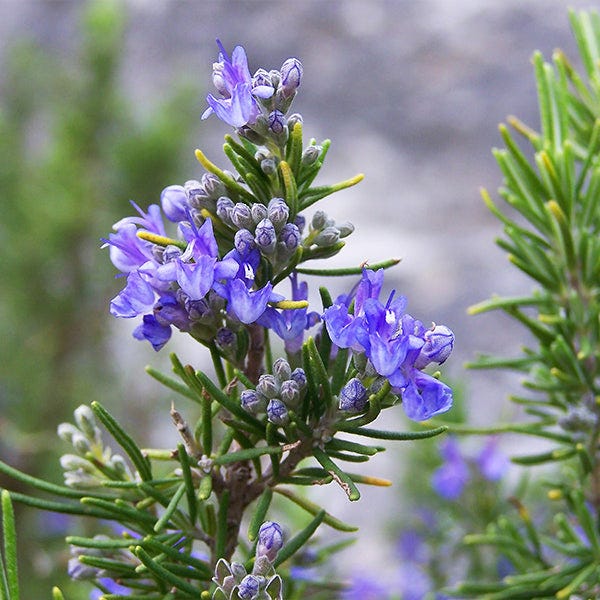
Not so The Magdalene. After her beloved is murdered by empire, by men convinced of their rightness and their justice, she sets out. Her boat has no rudder; it cannot be steered. She renounces control for where she is headed. Let the seas and their currents take her where she needs to go. She trusts the water and the earth on her pilgrimage back into the wilds. When she is washed ashore in Provence, a blue rose will bloom from where she has stepped. Some say that a blue rose is a miracle, an impossibility, a magical sign. But a blue rose is also rosemary in bloom, rosemary the ancient herb of rememberance. Here, in Provence, Mary Magdalene will remember who she has really been and who she really is.
The boat taking her from the Middle East, from Northern Africa to Europe is following an ancient pilgrimage of our ancestors who were following the migrations of the great herds, the seasonal abundance of the fields and forests. They were a people who walked around the planet carrying little but faith. No wonder Mary Magdalene seeks out a cave, because she is seeking a way of life that does not need buildings to maintain and storehouses to guard, churches to fund and erect and protect. She is leaving behind institutional permanence. She takes off her clothes, and like an animal again will wear only her hair. She is remembering how to be an animal again—without a nation, a religion, a team or a cohort, a special elect group of the chosen and the initiated. Who are the angels that feed her but the plants and animals of the land itself, those beings who recognize the Lady of the Beasts when she arrives.
One of the great mysteries of the Magdalene is how she gave her name to the paleolithic period (22,000 bc - 10,000 bc) that precedes the last Ice Age and the emergence of civilization, agriculture, armies and misogyny, and of course religion itself and the idea of god as a singularity. The Magdalenian Age was a twelve thousand year epoch where human beings reveled in a generative blossoming of artistic culture—painting, sculpture, musical instruments, storytelling that survives to this day, dance—without any of the domination and violence of patriarchal empire. Hunter-gatherers still these peoples ate a diet more varied and complex than we can imagine in our supermarket era. They did not need the sabbath or vacation because they only “worked” a few hours each day hunting and gathering, and even that so-called work included song and storytelling, joy and community. They were a people still intimate with each other, with plants and animals, with the ways of the earth. Why have they become associated with The Magdalene?
Five hundred miles north of her cave in Le Baume is another ancient rock shelter where some of the most beautiful artifacts from what was first called “The Age of the Reindeer” were unearthed in the 19th century as people began to recover the deep history of the planet.
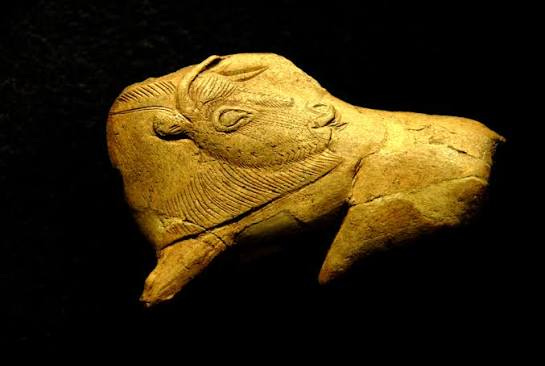
Above these caves was, coincidentally, a small old chapel dedicated to Mary Magdalene, and so that is how her name and these peoples became connected. Also dug up at this time were the paleolithic bones of a woman and a young child, their names lost in the dust, their story forgotten. How strange that a forgotten madonna and her child become connected to another mother written out of the story. Where do we find the Magdalene—at her home in Bethany, at her cave in Provence, or in an ancient grave site on the Vezere river?
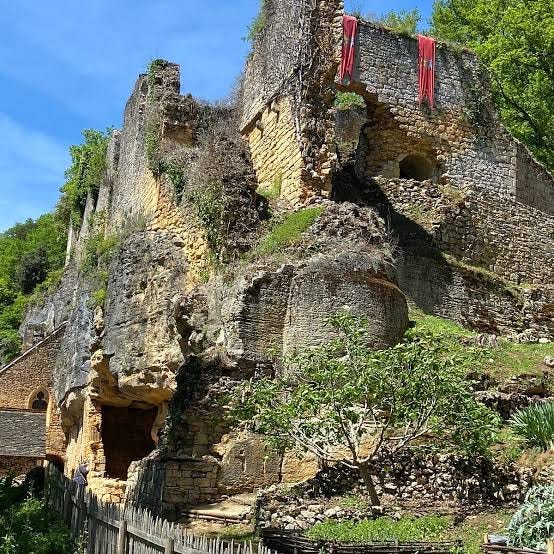
The Magdalene was given her nickname by her beloved who gave similar names to his friends—the brothers Thunder, the man who was a stone. Mig dalla means “tower” or “column.” Why does Yeshua call her that? What does it mean to be the tower itself? The Magdalene statue in the ruins of the chapel at the Abri Madeleine holds the alabaster jar of legend but it looks exactly like a tower, a tower that mirrors the striations of stone beneath her, leading down, down, down through epochs of rock, through time itself, down to the bottom of history. Miriam is this planet, this earth, this dirt and stone that brings forth life itself. She holds within herself the memory of all that we have been—the promise of all that we might be.
In prayer in her cave at St. Baume how many lifetimes was she remembering?
In prayer in her cave at St. Baume, wearing nothing but her hair, what was she praying for in her next incarnation?
Was she praying that her child would create a lineage of kings to cement the power of civilization’s reach? I doubt it. Would she be praying that women could put on the trappings of systems of dominance just like men? I doubt it. Or was she praying for a world where we would remember how to live like the lilies of the field, the birds of the air, our forbears who walked through the fields eating grain not caring if it was the sabbath because eating wasn’t work it was life.
I doubt she was praying to god. I think she was remembering her mothers and grandmothers, those woman who were the models for the devotional objects of those lost peoples of that forgotten Eden. I think she was not just praying to human beings but to the lions, the vultures, the roses and the rosemary, the stones and the rivers themselves. She took off her clothes and stepped naked back into the world.
Within hierarchichal systems of ever-increasing violence, we have tried to carve out for ourselves zones of safety and protection. We join this or that religious group, we vote for this party or that movement, we try to put on the right clothes so we’ll fit in, we get the right hats or head scarves or bumper stickers, we get along. But Yeshua calls us to be “no one,” to be a species again without nation, without tribe, without religion, without anything but the long story of our souls where we have been men and women, heroes and villains, plants and animals, and always each other’s mothers. Miriam shows us how to do this. We must be naked in the world again.
“Be ware of any venture that requires new clothes,” warned Thoreau in Walden, when he, too, tried briefly to step away from civilization.
The wilderness to which Yeshua and Miriam, and even Thoreau, could imagine returning has mostly been vanquished by one empire after another. We cannot imagine old growth forests filled with trees dropping nuts and fruits for us to feast upon. We cannot imagine streams brimming with fish easily caught. We cannot imagine the great flocks that only a few hundred years ago darkened the daytime skies. Nor do most of us have any of the ordinary skills of our paleolithic grandmothers—for starting a fire, finding shelter, healing with herbs, following the stars, all of the old ways.
Yet still I am inspired by the faith of Miram. She left the Roman world of cities and public baths and marketplaces and money lenders and off she went into an unknown world. How did she recover the skills to survive? How did she trust the angels to feed her and keep her warm and heal her heart?
July 22nd is her Feast Day and people will put on red robes in her honor, dye a few roses blue, and perform various rituals and ceremonies. I will step outside in my backyard barefoot and offer her this prayer:
Our Lady of the Beasts, Queen of the Column of Saints, Our Mother of Deep Time, I call upon you to heal our species of our delusions of control and importance. Help me to step into the rudderless boat of my soul’s pilgrimage and recover the lost wisdom of our grandmothers. I do not know where you will take me, only that you will always be with me. I bring to you today rosemary for rememberance so I, too, can remember who I have been and who I might become.
This is the first in a series of three essays to mark the sacred portal between the Feast Day of the Mother, Mary Magdalene, on July 22nd and the Feast Day of the Grandmother, St. Anne on July 26th. Next year in 2027 I am planning a weekend gathering, Mothers without Borders, so that we may honor and collaborate with our ancient mothers and grandmothers between the Shrine to Our Lady of Woodstock and the Miraculous Shrine to St. Anne in Kingston. Stay tuned for more information.
Perdita Finn is the author of Take Back the Magic: Conversations with the Unseen World, Mothers of Magic: Summoning the Wisdom of Our Ancestors, and with her husband Clark Strand The Way of the Rose: The Radical Path of the Divine Feminine Hidden in the Rosary. She teaches popular workshops on collaborating with our ancestors. She lives with her family in the moss-filled shadows of the Catskill Mountains. Find out more at takebackthemagic.com

With the roar of a thousand mothers and theirs before them, yes!!! This might be my favourite writing of yours to date - which is saying a lot. 🌹🌲
“She took off her clothes and stepped naked back into the world.” Yes, this. So simple and so hard. What a beautiful honoring your words are of the Magdalene for her feast day. May she teach us all how to trust our rudderless boats. ❤️❤️